
This paper is published in the BMJ Open.
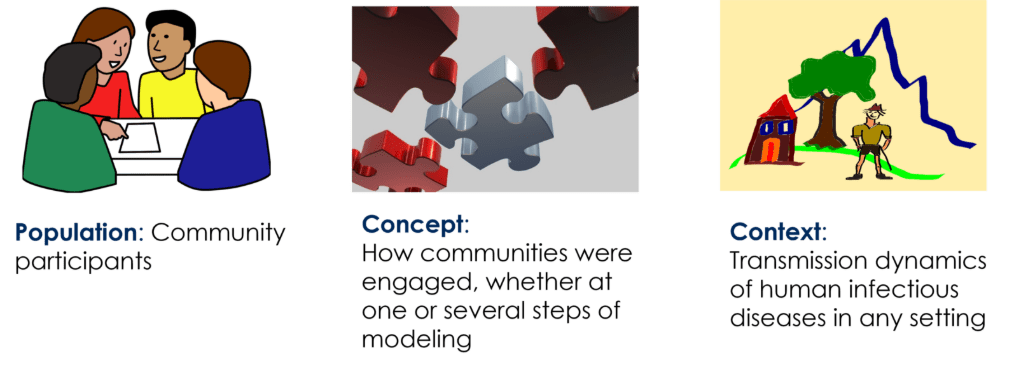
Figure 1: Framework for defining the scope of the proposed study. This figure illustrates the structure used to guide what information we synthesize in the proposed review: who is involved in modeling, what approaches are used to engage with them, and the disease context the modeling study takes place.
Summary
Why did we conduct this study?
Mathematical models of infectious diseases are commonly used in public health to inform policies and programs that affect the lives of communities. Models help us study how infections can spread and to test scenarios on how to prevent or dampen outbreaks and epidemics. Developing and analyzing models with community participation could make models more relevant to the needs of communities. Community engagement could also make the models more robust and reliable by drawing on knowledge where traditional data do not exist, by testing assumptions, and by reducing potential harms that could stem from models (such as stigma from the traditional jargon or language used in modeling studies).
Communities refer to people with lived experience. Other key interest holders include policymakers and public health professionals.
We know little about how modeling studies have engaged with communities. One way to find out is to map out what has been done before and “critically synthesize” the approaches that have been taken with communities to date. Mapping evidence using a critical synthesis is a way of not just summarizing information but uncovering patterns against established theories and approaches and then proposing a way forward.
What will we do?
We developed a protocol for a scoping review to examine the gap in what we know about community engagement in modeling studies (knowledge gap) and how to do it (methodological gap). A scoping review is a type of research method that allows us to map existing evidence to identify gaps. In our protocol, we describe each step of how we will source the literature and find what we are looking for. Importantly, this review and synthesis involves working with community members, through our partnership with HEKA (Health Research Intervention Kuthamini Afya Yetu), a network of community members from community organizations that serve sexual and gender minorities in Kenya.
Once we find the studies, we will review them to answer the following questions:
- What approaches were used to engage with communities, and at what steps of the infectious disease modeling?
- What was done during the modeling study to advance equity for the communities engaged, that is, shifting power dynamics such that communities had influence, felt valued, and gained capacity through knowledge sharing, and were positioned for future similar modeling studies?
Examples of how communities might have been engaged include but are not limited to: defining the research question, helping design or interpret models, or using the results in advocacy or policy.
To answer the two questions, we will use a type of synthesis called “deductive” synthesis by extracting relevant information from the studies we find through mapping what the studies report to predefined categories. The predefined categories for the approaches are drawn from community-based participatory research frameworks and established steps of infectious disease modeling, and the categories for equity advancement are drawn from a framework for evaluating equity in researcher-community partnerships. In parallel, we will also use a type of synthesis called “inductive synthesis,” where we will identify emergent themes that reflect how communities themselves describe their engagement, influence, and capacity growth within the modeling process.
What could we learn from this work?
To our knowledge, the study will provide the first systematic and comprehensive synthesis of community engagement approaches used to date in infectious disease modeling. We will be able to:
- Map out the spectrum of approaches, including participatory approaches used in practice
- Highlight where engagement has been limited
- Propose a framework for how to foster inclusive modeling.
This synthesis is part of a body of work that aims to advance methodologies in infectious disease modeling by centering the knowledge, experiences, and expertise of affected communities. The ultimate goal is not just more relevant, robust, and reliable models, but modeling that serves to help reduce health inequities.
Funding
This work is part of Nancy Tahmo’s PhD thesis, and is supported by the New Frontiers in Research Exploration Grant, the Canadian Institutes of Health Research Planning and Dissemination Grant, the Emerging and Pandemic Infections Consortium (EPIC) Doctoral Award, and Unity Health Toronto Angels Den Scholarship.
 Mishra Lab